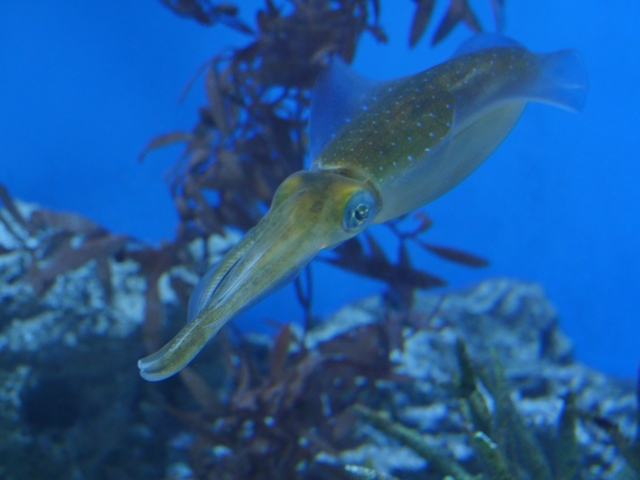
This blog is normally about squid, amberjack, and where to stand on the rocks in Wakayama. Today it is about a book, which is a first for me, so bear with me.
There is an old saying that gets passed around among anglers. You have probably seen it somewhere.
If you want to be happy for an hour, drink wine.
If you want to be happy for three days, get married.
If you want to be happy forever, learn to fish.
Nobody seems to know who said it. Some people credit Laozi. The truth is probably lost, which has never stopped anglers from passing the line around among themselves like a flask.
I wanted to know whether it was actually true.
I am forty-two. I have been fishing since before I can remember, and at forty I moved to the Pacific coast of Wakayama, into an old farmhouse that cost about ten thousand dollars. There was also a period when something inside me broke and I could not leave the house, and what eventually got me back outside was, again, fishing. Which puts me in a decent position to test the saying against my own life.
So I did, and the result is a short book.
What the book is
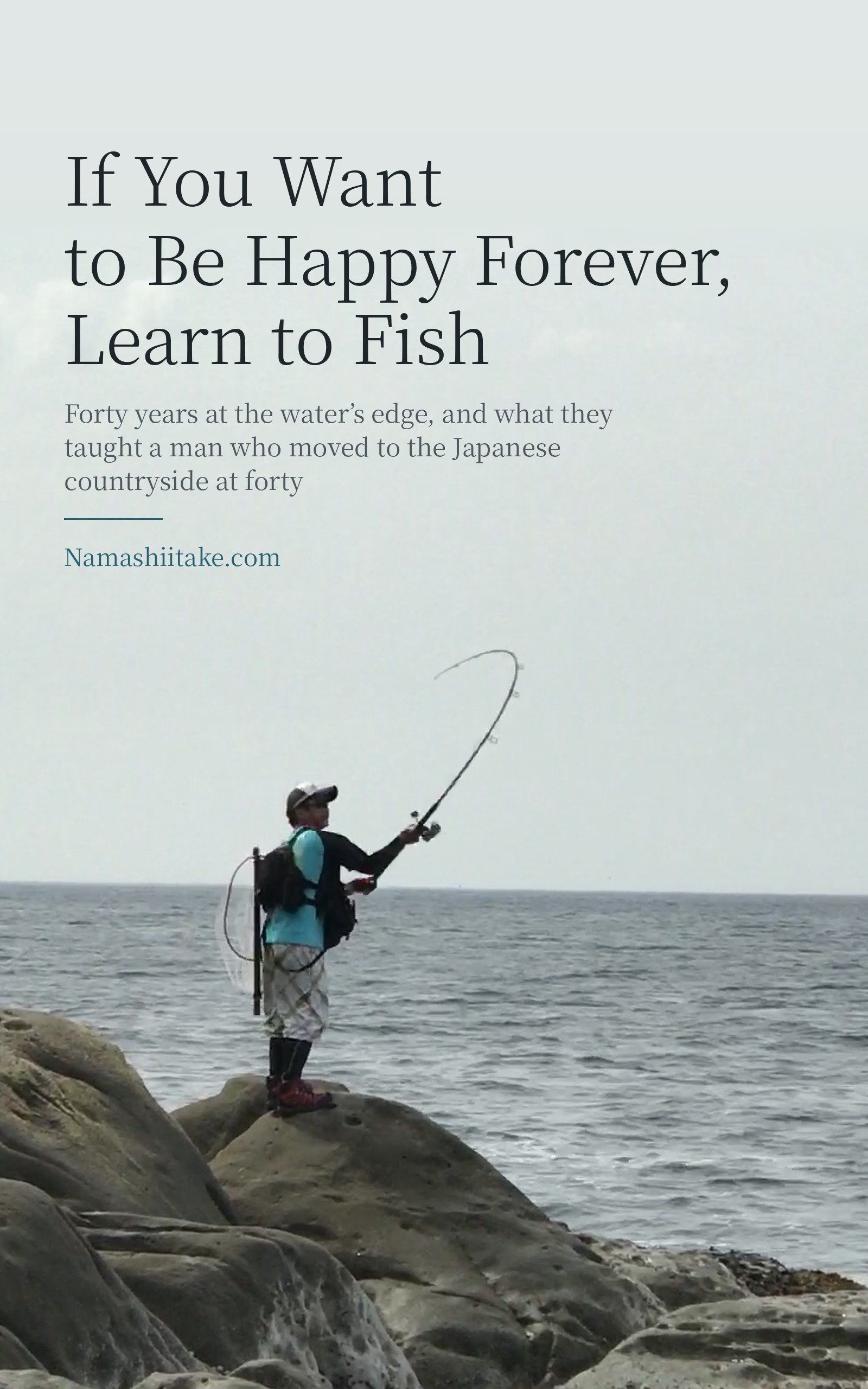
It is called If You Want to Be Happy Forever, Learn to Fish. Five chapters, around 6,500 words, with photographs from the coast.
- Chapter One: A Small World on a Raft — being taken out at seven onto a fishing raft in Wakasa Bay, on the Japan Sea, because my father’s only two pastimes were fishing and pachinko
- Chapter Two: The Year They Called Me Catfish — the bass craze of the late nineties, the Kamo River in Kyoto, and a nickname earned by catching the wrong fish
- Chapter Three: From Being Taught to Teaching — university, and the discovery that the best part was handing the rod to someone else
- Chapter Four: Facing the Sea, Thinking Nothing — the months after graduate school ended badly, spent driving the Kii Peninsula and sleeping in the car
- Chapter Five: If You Want to Be Happy Forever — what living five minutes from the water is actually like, told honestly
There is no tackle advice in it. No fish is measured for its own sake. It is a book about what one small pastime, handed over by accident, does to a life across forty years.
Why I wrote it
It started as an idle question, and turned into an accounting.
Working through it chapter by chapter, I found I was listing what fishing had actually given me, decade by decade. As a child it gave me travel — the drive, the tackle shop, the boat, the packed lunch, all of it as one thing. At thirteen it gave me friends and a stupid nickname. At twenty-two it gave me something to hand to other people. And when everything else stopped working, it gave me somewhere to go.
What surprised me was the beginning of the chain. My father had exactly two hobbies, fishing and pachinko, and you cannot take a small child into a pachinko parlour. That is the entire reason the destination was always the sea. One accident of scheduling, forty years ago, eventually chose the ground I am standing on.
The largest squid of my life, in the emptiest months of my life
Here is a passage from Chapter Four. If you fish egi for squid, this is probably the part of the book that will land hardest.
Background: I had quit graduate school on the last day of the submission deadline, spent two months unable to leave a room, and then started driving south along the coast with a camp stove in the boot and no plan at all.
I did not fish every day. There were days I never took the rod out of the car. There were days I sat and looked at the water, and days I did not get out of the back seat at all. I did whatever I felt like doing that day, and nothing else.
Mostly what I was doing was not thinking.
In those years the warm current swung close to the point, and from winter into spring there was a window when what we call the red monsters — reef squid of absurd size — would come up now and then.
I had gone down to the rocks that evening for no particular reason, expecting nothing. Then the line went heavy — not a strike, nothing that sharp. Just weight, the way a door feels when someone is holding it shut from the other side.
[…] When it finally came up over the ledge it was pale and enormous and furious, and I sat down on the wet rock with it, breathing hard, and for the length of about a minute I was not thinking about the thesis, or the room I had not left in two months, or any of it. Close to nine pounds. I was off the rocks by eleven.
And then, a few lines later, the sentence I still cannot resolve:
In the period of my life when I was doing the least, I caught the fish of my life. I have never known what to do with that.
I did not earn that squid. I had not been grinding a spot for a week. I went down on a whim in the evening and was back off the rocks before midnight. That is how it happened, and I have stopped trying to make a lesson out of it.
Does living five minutes from the sea make you fish every day?
No. And Chapter Five is mostly about why not.
I bought a house close enough to the sea to walk to it, so I assumed I would fish nearly every day.
In practice it is two or three times a week, if that.
I like fishing. That is not in question. But if there is a bit of wind, I do not go. If I feel vaguely sleepy, I skip it and go back to bed.
The reason took me a while to work out, and when I did it was uncomfortable. The sea here is too close.
A thing that sits right there stops being a thing you make a trip for.
When I lived in Osaka I drove an hour and a half each way. I packed the night before and left in the dark, and every session was a small expedition. Now I am at the water on a whim, and to exactly that degree, fishing has stopped being a journey.
Chapter Five also covers the things people tend not to put in the moving-to-the-countryside posts: earnings fall, there are simply fewer people your own age, and one day you will not be able to drive — which out here is not an inconvenience, it is the end of a functioning life. I also admit, in print, that I have lately caught myself thinking about going back to Kyoto or Osaka.
It is not an argument for moving, or against it. It suits a person or it does not, and you probably cannot find out without doing it. For what it is worth, I am glad I did.
So — is the saying true?
The answer takes the last chapter to arrive at, so here is only the hinge of it.
If you want to be happy forever does not mean you will be smiling the whole time. It means: keep hold of one place you can come back to, whatever happens.
That is where forty years put me. It is not a dramatic sort of happiness. But having a sea in your life that you can disappear into on any afternoon — I think that counts.
Who it is for
- Anglers who cannot explain to themselves why they fish. I could not either. Writing it down got me about halfway.
- Anyone thinking of moving somewhere remote for a hobby. The book spends more time on the costs than on the postcard.
- People who go to the water when work has gone badly. Chapter Four is about nothing else.
- Readers who like quiet writing about ordinary Japan — the parts with no temples in them.
If you came here looking for a rig diagram, this one is not for you. The rest of the blog has plenty of those.
A note on the Japanese edition
There is a Japanese edition, published a few days earlier, and I should be clear that this English book is not a translation of it. Same life, same forty years, but written again from the beginning as an English essay. Some passages exist in one edition and not the other. If you read Japanese, the title there is 「永遠に幸せでいたいなら、釣りを覚えなさい」は本当か.
Where to get it
It is on Kindle, with five photographs from the coast — the rafts in Wakasa Bay, Lake Biwa seen from a train window, a fire burning after dark.
If You Want to Be Happy Forever, Learn to Fish on Amazon
Next post, we are back to the rocks in Wakayama as usual. Thanks for reading this one.