Most of my tackle gets bought on price. These six did not, and they are the only purchases that changed how I actually fish rather than just what I own.
Every one of them removed a specific annoyance. That is the only thing they have in common, and it turned out to be the thing that mattered.
1. A gaff instead of a landing net, for squid
This is the one that surprises people who fish outside Japan, so I want to explain the reasoning rather than just name the tool.
When you hook a bigfin reef squid (aori-ika) on an egi — the Japanese shrimp-shaped squid jig — the hooks catch near the arms, at the front end of the animal. So the squid comes in toward you arms-first, with the mantle — the pointed body end — facing away from you, out to sea.
That matters because of the direction a squid runs. A squid escapes by jetting water, and when it does it goes mantle-first, pointed end leading. Since the mantle is already facing away from you, every escape burst takes the squid further out, away from the rocks you are standing on.
Now try to net it. Because the arms are on your side, you cannot drop the hoop straight down — you have to reach it out past the squid, get it on the far side, and draw the net back toward yourself to scoop the animal up. If the squid jets while you are doing that, it runs out over the far rim, the same edge the hoop just came over. The net is travelling one way and the squid is travelling the other. It is much harder than it sounds, and I lost a lot of squid that way.
A gaff removes the whole problem. You reach out, you set the point, and it is done in one movement. There is nothing to line up and nothing to draw back.
I used to hate gaffing. My old setup was a long, heavy landing net pole with an auto-opening gaff head on the end, and the weight was the problem — holding that much length out at arm’s length, you cannot place the point where you want it. Missing a good squid with a tool that heavy is a specific kind of frustrating.
Switching to a short, light gaff fixed it completely. Mine is a Kanji International Short Gaff III, 4 m (about 13 ft). “Short” is relative — it is short compared to a landing net pole, not short in absolute terms. Because it is light, I can hold it out one-handed and put the point exactly where I mean to. I now look forward to the gaffing part, which is not a sentence I ever expected to write.

One thing worth saying plainly: a gaff kills the squid. I use it on squid I am taking home to eat. If you release your catch, this is not the tool for you and a net is the right answer.
The other half of the setup is a magnetic releaser (mine is a Kahara) plus a coiled lanyard, so the gaff hangs on my vest and comes off with one pull. A gaff you have to unclip is a gaff you leave in the bag.
If you are shopping for one: Kanji International is a Japanese brand and is hard to get outside Japan — the model I use has already been replaced by a newer version there. What you actually want is the weight, not the badge. Look for the lightest 4 m (13 ft) class gaff you can find, one you can hold out at arm’s length one-handed without your wrist shaking, with a single small hook and a magnetic releaser to hang it on.
2. Rock boots with tungsten pins
I fish from iso — wave-washed rock ledges — and footwear is the one piece of gear on this list where the wrong choice is dangerous rather than just annoying.
Felt soles and plain rubber soles are close to useless on that kind of rock. Not “less good”. They slide.
Studded soles are the answer, and the studs come in different metals. I have settled on tungsten pins and I will not go back to stainless. Tungsten grips better, and the durability is not in the same category — the pins keep their bite, and they do not rust.
Mine are mazume MZWD-281s. I have had them for years of heavy use and the first thing to fail was the laces. Not the sole, not the upper — the laces.
Where they still slip: rock that sits underwater permanently and has a coating of algae and slime on it. Nothing grips there, whatever metal is on your feet. That is not a gear problem to solve, it is a place to stay off.
If you are shopping for one: mazume is Japanese and the model I own has already been superseded. The specification to chase is tungsten pins rather than stainless, pins that can be replaced when they eventually wear down, and a snug fit — a boot that moves on your foot puts the studs somewhere other than where you aimed them.
3. A chest light, and why I am not using it right now
I want to be straight about this one, because I have moved away from it and the reason has nothing to do with the light being bad.
The case for a chest light is simple: your cap. A headlamp sits above the brim, so the brim cuts the beam exactly where you need it — the ground just in front of your feet. Walking broken rock in the dark, that is not a small thing. A light on your chest sits below the brim and throws straight down at the ground you are about to step on. Mine was a Hapyson INTIRAY, waterproof and genuinely bright — bright enough to be the only light I carried.
Then I started mounting an action camera on my chest, and the two of them want the same piece of real estate. The camera won. I went back to a headlamp and I now live with the brim shadow.
The other limitation, which is real regardless of cameras: a chest light points where your body points. When you turn just your head to look at something — and in fishing you do that constantly — the beam stays where it was. You end up moving the light with your hand.
So: if you are not filming, I think a chest light is the better tool of the two, and the brim problem it solves is a bigger deal than the head-turning problem it creates. I gave mine up for a reason that is specific to me.
If you are shopping for one: Hapyson is another Japanese brand that is awkward to buy from abroad, but chest lights are made elsewhere too and the specification is what matters. You want it properly waterproof rather than “water resistant”, bright enough to be your only light so you are not carrying two, and — if there is any chance you will mount a camera on your chest later — as narrow as you can find.
4. Rechargeable NiMH batteries — the cheapest thing here
This might be the item that improved my comfort the most, and it is by far the least glamorous.
I moved every battery-powered thing I fish with from alkalines to NiMH rechargeables — mine are 3000 mAh AAs. Two reasons, and neither is exciting: buying and restocking alkalines is a chore, and over any real span of time rechargeables are far cheaper.
The numbers, in case they help you size a set: my headlamp runs on a single AA. A night’s fishing costs me two or three cells, because I swap early rather than waiting for the light to fade. I carry sixteen charged cells, which is far more than a night needs — the rest are simply spares, and I would rather leave the house with everything topped up than ration them.
I charge them in the car, using an inverter on the 12 V socket, which means a multi-day trip does not need a plan.
Years in, they have not noticeably faded.
If you are shopping for one: this is the one item on the list with no sourcing problem — good NiMH AAs and a decent multi-bay charger are available everywhere. Check the device you care about most, though: a light designed around one AA is much easier to keep running than one that eats four.
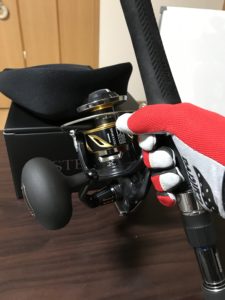
5. The reel: Shimano Stella SW 14000XG
I should be honest about why this reel is on the list, because “buy the expensive reel” is not useful advice on its own.
I did not buy this size for general shore fishing. I bought it for large yellowtail amberjack (hiramasa), and for a trip to Tokunoshima, in the islands south of mainland Japan, to try for giant trevally. That is what justifies a 14000-class reel. If that is not the fishing you are doing, a smaller reel is not a compromise, it is the correct tool.
What it changed, on the water: the retrieve is light. Working a diving pencil for hours stopped being tiring. In a retrieve-heavy style of fishing, that is the whole game — and once you have fished with a reel like this, going back to anything else is genuinely hard.


Seven years in, I have had no failures at all. I send it for an overhaul once a year and that has been the entire cost of ownership.
If you are shopping for one: mine is the 2019 SW, and it stayed popular enough that it is hard to find even in Japan now. Do not chase that exact model. The things that make it work are the specification, not the year: a 14000 size, a high-speed gear ratio, a properly sealed drag, and a body built for saltwater. Buy the current version of that, from whichever maker you can actually service where you live — an annual overhaul is part of owning one of these, so being able to send it somewhere matters as much as the purchase.
6. The camera, and the blog
I carry a camera to film for YouTube. That is the whole reason, and I will say up front that it did not change how I fish — I do not fish differently because there is a lens on my chest.
What it changed was who I fish around.
I still fish alone, and I still like fishing alone. But through the videos and through writing this blog I have ended up talking to other anglers, and getting to know pro staff and testers I would never have met otherwise. The fishing is still solitary; the sport around it stopped being. That is the part I did not expect, and the part I would not give up.
The hardware has moved on. I started with a GoPro; mine eventually started overheating badly, and I wanted something better in low light for night sessions, so I switched to a DJI Osmo Action. Similar tool, different badge — and action cameras get replaced often enough that any specific model recommendation would be out of date before you read it. What matters is that it is waterproof, that it survives being knocked against rock, and that it does not shut itself off halfway through a session.
What I would change
I went back through all six and asked myself which one I should have bought cheaper. The answer was none of them — and I do not think that is me defending my own spending.
The gaff fixed missed squid. The boots fixed slipping. The light fixed the brim shadow. The batteries fixed running out. The reel fixed a tiring retrieve. Not one of them was bought because it was good in the abstract; each one was bought because something specific had already gone wrong.
And the one that gave me the most comfort per unit of money is the cheapest thing on the list, by an enormous margin. It is the batteries. It is always the batteries.
If there is a seventh, it is line — good PE braid. Strong, easy to handle, and the difference between cheap and good is obvious the first time you use it.