Have you had a good fishing life?
A workmate came to me the other day and said he was determined to finally catch a squid this season. He’d been watching eging videos on YouTube every night. His question was simple: how do you catch lots of them?
I listened for a while, and it became clear he had missed the one thing that matters most.
You hear a lot about jerking — this jerk, that jerk, the violent jerk. You almost never hear anyone talk about the fall. But the jerk is only there to bring the squid in and switch it on. The squid actually takes the egi while it is sinking.
So yes, the jerk matters. The fall matters more. This article is about why a stable fall is the whole game, and how to get one.
Why a stable fall matters so much
For a long time I could not have told you why. I only knew that it worked.
What changed my mind was watching squid in clear water, from the rocks, close enough to see what they actually do. And what they do is this: a squid that sees an egi sinking strangely — twitching, wobbling, unstable — turns away. Even the big ones. Especially the big ones.
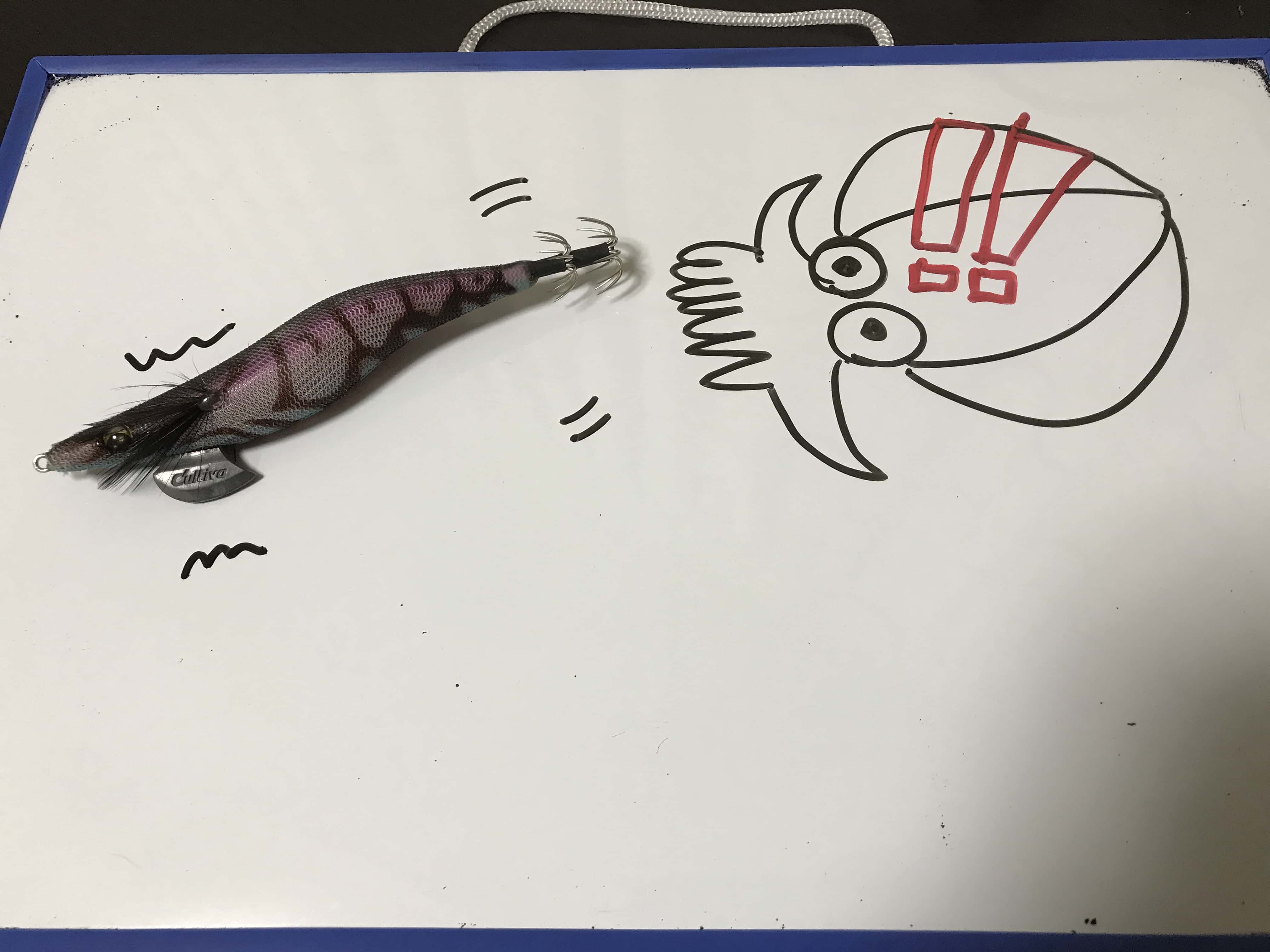
I should admit that it took me a full year from starting eging to land my first squid. That year was spent watching, mostly. And what I saw, over and over, was:
The squid comes in while the egi is darting.
The egi stops, and the squid sits back and watches it.
The egi twitches once, and the squid backs off.
But when the egi sways with the swell, the squid does not back off at all.
That last one is the key. A squid is not spooked by movement. It is spooked by unnatural movement. Swell is natural. A nervous hand on the rod is not.
Once I started leaving the egi alone on the fall, I began catching squid. That is the whole story, and it is why I say the stability and posture of the sinking egi is the single most important thing in this style of fishing.
How to get a stable fall
Squid hit the egi while it is sinking or sitting still. Which means the moment you are waiting for a bite is exactly the moment you are most likely to ruin it.
Here is what happens. You concentrate. You focus on the line, waiting for the weight to come on. And without noticing, you grip the rod harder. The rod tip shivers, the line telegraphs it down, and the egi twitches. The squid that was three metres away turns and goes.
If you have never landed a squid, try this: hold the rod loosely while you wait. That is it. That is the tip.
Just being conscious of leaving the egi genuinely still is often enough to turn a blank session into a fish.

Posture: the second dial you can turn
You do not have to obsess over this, but it is worth knowing that squid respond differently depending on the angle the egi sits at as it falls.
Some days they will only come to an egi that falls nose-down at an angle. Other days they only want one that stays horizontal. There is no rule for which day is which, so treat it as something to test.
If you have fished a spot for a while and nothing has touched the egi, change the posture before you change the egi. It is not unusual for the bites to start immediately.
The controls are simple:
Keep tension on the line → the egi holds a more horizontal posture
Release the tension → the nose drops and the egi falls at an angle
Those two states have names in Japanese eging, and they are worth learning because they describe two genuinely different tools.
Tension fall
A tension fall is when you keep the line tight and let the egi sink on an angle, swinging back toward you.
PE line floats, so it lies on the surface above the egi and enters the water from above it. When you keep the line taut, the pull that reaches the egi through the leader comes from in front and above.

Line tension and the direction of the fall
That forward-and-up pull combines with the egi’s own sink rate, so it travels toward you as it goes down, like this.

Tension fall is good for feeling the take and keeping control of where the egi is.
Tension fall is bad for getting down quickly, or for working a small area thoroughly.
Free fall
A free fall is when you give slack and let the egi drop almost vertically.
With no tension coming through the leader, there is nothing pulling the egi forward, so it goes more or less straight down.

The direction of the fall with no tension
Because the egi barely moves toward you, you can search a piece of water in small steps instead of dragging it back with every cast.

The trade-off is that you feel much less. A squid can take the egi on a free fall and you will only know when you tighten up and find weight there. Watch your line for that reason — a slack line that stops sinking, or twitches sideways, is a squid.
Summary
The stability and posture of the egi on the fall is the most important thing in eging.
Eging = jerk + action + the fall
Most people learn the first two from videos and never think about the third. Get the fall right — loose grip, no unnecessary twitching, and a deliberate choice between tension fall and free fall — and squid start coming to an egi that has not changed at all.
Eging for beginners: the 4 essentials to start squid fishing