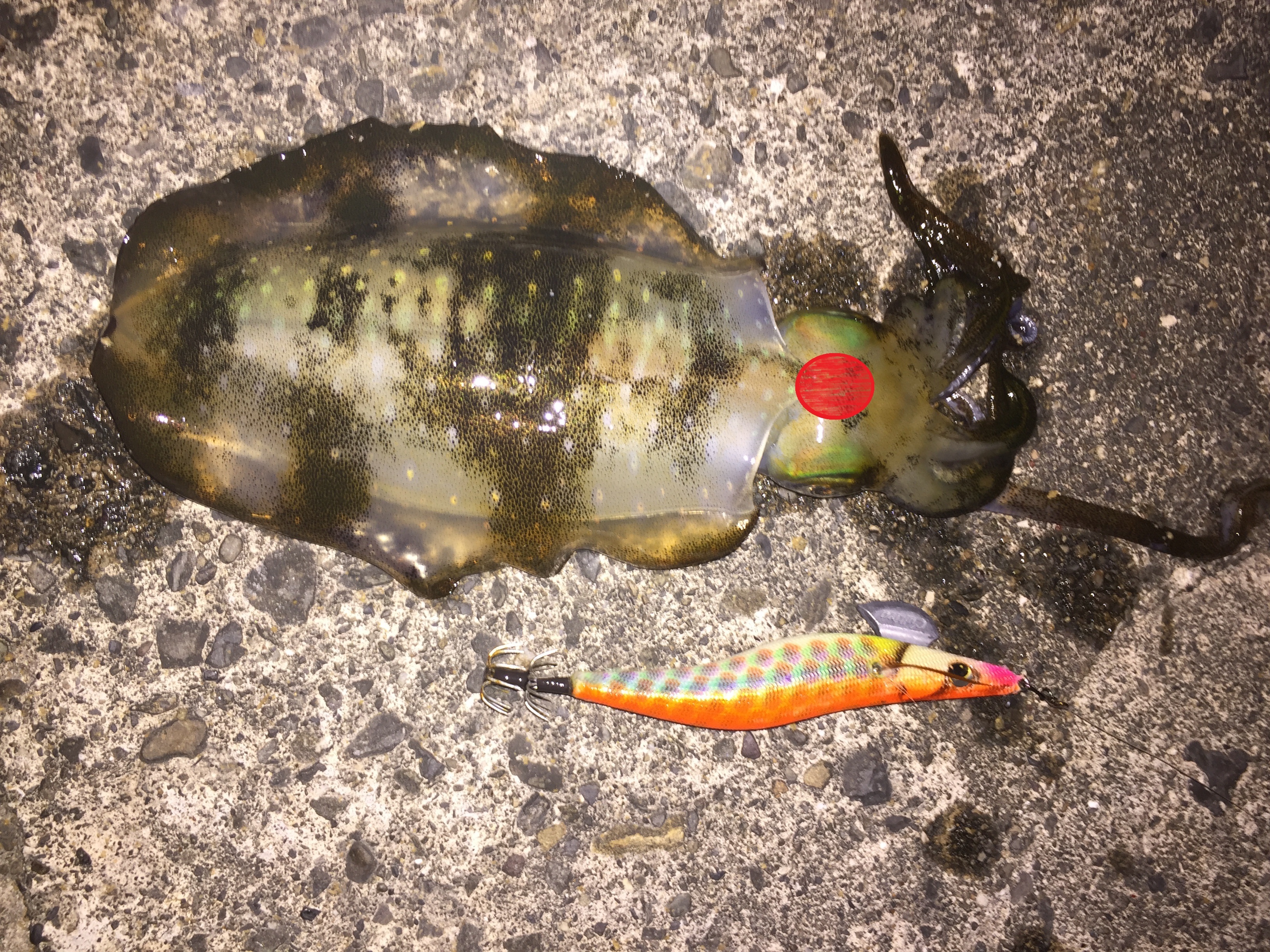
Eging — lure fishing for aori squid (bigfin reef squid) — has exploded in popularity partly because it is so easy to get into. But even an easy style of fishing has a few things you simply cannot do without.
The good news is that there are only four of them. Get these four and you can start eging.
1. The Eging Rod
Almost every style of fishing has a rod built specifically for it, and eging is no exception. Some rods can be borrowed from other disciplines, but eging is one of the styles where I really don’t think you can substitute. (You could force it with a bass rod, but I wouldn’t recommend it.)
There are several things to look at when choosing a rod — length, weight, power. Since you are spending money on it anyway, it’s worth understanding what you’re buying.
The specifications are printed on the blank near the grip and on the box, like this.

Here’s what those markings mean:
S806M — the numbers are the length (806 means 8 feet 6 inches). The letter is the power, which I’ll cover below.
LINE — the line sizes the rod is designed for.
EGI SIZE — the egi sizes the rod can handle. (Some rods list this in grams instead.)
LENGTH — the length of the rod.
Rod length
Eging rods run from about 7 to 9 feet. Each has its strengths and weaknesses, but for your first rod, go with something around 8’0″ to 8’6″.
Why? Because it’s the middle of the road — easy to handle, no quirks.
A longer rod casts further, handles shallow ground better, and has more power. A shorter rod is easier to work in tight spots and easier to jerk. Both have their place, but start in the middle or slightly short, then buy something long or short once you know your own preferences. I’d suggest buying cheap on the assumption you’ll replace it. Eging isn’t a punishing style of fishing, so a budget rod won’t break easily, and honestly you can’t know what suits you until you’ve fished with something.
That said, I’d avoid those rod-and-reel combo kits for the price of a takeaway meal. Some of them are fine, I’m sure. The first one I bought snapped at the tip on my second trip out, on a jerk.
The single most important thing about rod length is actually something the spec sheet doesn’t tell you: the distance from the reel seat to the butt end of the rod.
Choose a rod where that distance is shorter than from your palm to your elbow. Any longer and the butt catches on your body every time you jerk, which makes the whole day miserable. Start there, and next time you can go a little longer or a little shorter and know what you’re changing. (This one matters. If you take nothing else from this section, please take this.)
For what it’s worth, a longer butt section helps you cast further and shifts the balance point towards the reel so the rod feels lighter in the hand (the total weight goes up, of course). I personally use a rod that’s just slightly shorter than my elbow.
Rod weight
Most eging rods weigh somewhere between 100 g and 150 g. Some come in under 100 g, but those are expensive and not worth worrying about at the start.
In eging you are swinging the rod all day long to work the lure, so lighter is better. But how a rod feels in the hand isn’t decided by its own weight alone. It’s the balance between rod weight, reel weight and rod length that determines whether it feels heavy or light.
So don’t obsess over grams. Pick something under about 150 g, then mount a reel on it and give it a swing. A rod that feels light is one whose balance point sits close to the reel seat — near the axis you’re rotating around.
That “mount a reel on it” part is the key. Two rods of identical weight can feel completely different. Don’t just help yourself to the display stock in a tackle shop, though — get friendly with the staff and ask whether you can put a reel on and wave it about.
Rod power
Eging rods come in four main powers.
L — soft. Casts light egi a long way and is less likely to pull the hooks on a subtle take. Not suited to casting big egi long distances or targeting large squid.
MH — stiff. Plenty of power for big squid, throws heavy egi a long way, and copes well with fast current. Not suited to small, light egi in the 2.0–2.5 range.
M — between L and MH.
ML — between M and L.
They all have trade-offs depending on the egi you throw and the size of squid you’re after, but for a first rod I’d choose M — middle, leaning slightly soft. When you’re starting out you’ll mostly be fishing accessible breakwaters, where the standard egi sizes are 3.0 and 3.5. So look for a rod that lists both 3.0 and 3.5 in its egi range.
(Starting with 4.0 egi is exhausting and no fun; starting with 2.0 makes bites hard to detect and also no fun. 3.0 to 3.5 is the sweet spot.)
Bear in mind that these M and MH designations vary between manufacturers, and “stiff” can mean crisp and fast or stiff with a slower, more forgiving action. Don’t be too precious about it at the beginning.
2. The Reel
The reel holds and retrieves your line. Reels vary in size, line capacity, weight, drag power and more, but at the start you only need to think about size, capacity and weight. The specs are printed on the spool and on the box.

Here’s what those markings mean:
C3000S — the number is the reel (strictly, the spool) size.
PE 0.6–200m — it holds 200 m of PE 0.6.
Reel size
The number printed on the reel (3000 in the photo) is the size — but the relationship between that number and the actual size differs between manufacturers. A Daiwa 2500, for example, is roughly equivalent to a Shimano 3000. It’s confusing, but the short version is: a 3000 in Shimano or a 2500 in Daiwa is the right size for eging.
The reel in the photo has a single grip on the handle (a single handle). Reels are also made with two grips, called a double handle.
Nearly every pro you see on a fishing programme is running a double handle. I’ve tried one, but having used single handles for so long it just felt wrong to me and I went back. Depending on the model, you can also buy a reel with a single handle and swap the handle for a double later.
Single vs double handle, roughly speaking
Price
single < double
How much the handle spins on its own after you let go
single > double
Looking like you know what you’re doing (in my opinion, anyway)
single < double
Weight
single < double
Cranking torque
single > double
Personally, since I’m working the lure all day, I’ll take every gram I can save, and when I want to snap off a single quick turn of the handle I find a single handle easier. So I’m in the single camp. But reading around online, I get the impression eging anglers lean slightly towards double handles.
Reel weight
Reel weight isn’t printed on the reel itself — check the box, or just pick it up. If you can, mount it on the rod you intend to buy and give it a swing. If you feel the balance point sitting a long way from the reel, either go heavier on the reel or lighter on the rod. The closer the balance point sits to the reel, the easier the outfit is to fish.
At the beginning you don’t need to count individual grams. In all honesty, a difference of 10 g really does show up in how tired you are after a full day — but light reels are almost always expensive, and there’s no way around that. Compromise a bit at the start. “Doesn’t feel too heavy when I swing it” is good enough.
Line capacity
Every reel holds a set amount of line. The one in the photo takes 200 m of PE 0.6.
Eging mostly uses PE in the 0.5 to 1.0 range, so anything that holds 100 m or more of PE 1.0 will be fine.
3. PE Line and Leader


Eging uses two kinds of line.
PE line (braid) goes on the reel — the first photo above.
Leader connects the PE to the lure — the second photo.
A quick note for readers outside Japan: Japanese line is sized with the gō (号) system, which is based on diameter rather than breaking strain. PE 0.8 is roughly 0.15 mm; the pound rating varies by brand and by how many strands the braid uses, so treat any lb figure as a ballpark.
PE line
Eging mainly uses PE in the 0.5 to 1.0 range. Ideally you’d match it to the current, the size of squid and the egi you’re throwing, but to start with, 0.8 with about 100 m on the reel handles most situations and won’t part the moment it touches something abrasive.
I’ve spent this whole article telling you to save money. This is the one place I’d say the opposite: don’t skimp on PE line. Cheap braid goes fuzzy and frayed very quickly and becomes unfishable, and cheap line seems to cause far more tangles. If you want your first sessions to be fun rather than infuriating, buy at least a mid-range braid.
Leader
The leader is the section of line between the PE and the lure. PE has poor abrasion resistance and can’t be tied straight to a lure — well, it can, but it will fail almost immediately. So you tie on a length of nylon or fluorocarbon, and fluorocarbon is the one to use.
Eging-specific leaders are sold, but you don’t need one. About 30 m of fluorocarbon in 1.5 gō (roughly 0.20 mm, around 6 lb) is plenty. There’s no need to buy anything expensive here — just make sure it’s fluorocarbon.
4. Egi (Squid Jigs)
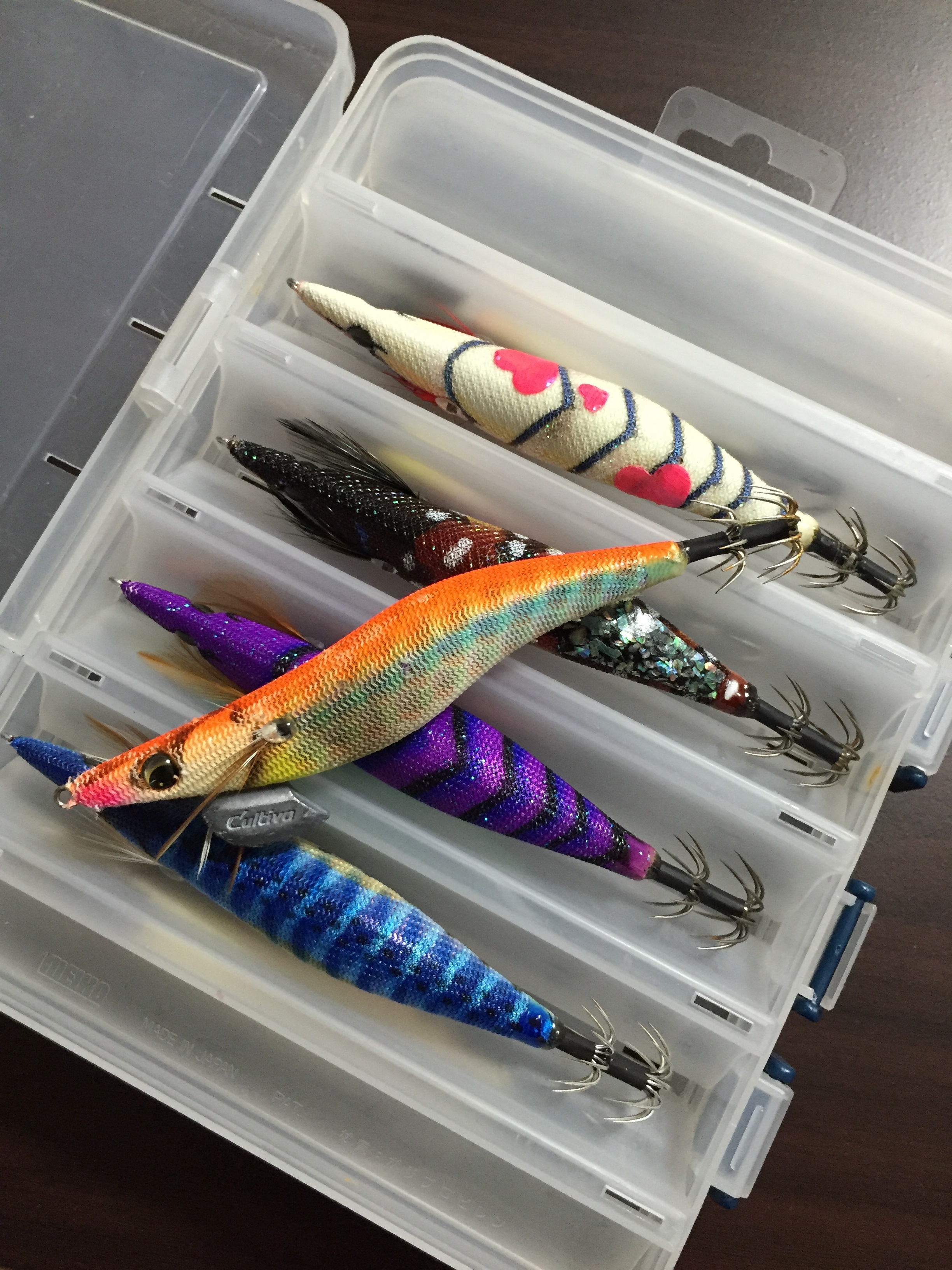
An egi is a lure shaped like a prawn. As you can see in the photo, they come in an enormous range of colours and shapes. The three things to look at when choosing one are size, weight and colour.
Egi colour and pattern
Squid are colourblind, so they don’t see colour the way we do. (Research is still ongoing and there’s no settled answer yet.)
And yet anglers know from experience that egi colour makes a real difference to the catch. I’ve studied biology as part of my work, so I have a few thoughts on this. Squid visual pigments aren’t the same as ours. We still don’t know what the world looks like to a squid, but recent research suggests their visual pigment responds well to wavelengths near blue, green and violet. Where humans have three types of colour-sensing cell, squid have been shown to have only one — and it responds best to those blue-green-violet wavelengths, which raises the possibility that squid see blue, green and violet more clearly than other colours.
That doesn’t mean other colours are invisible to them. My guess is that they see the rest in shades of light and dark, and that what actually moves the needle on catch rates is whether an egi reflects, absorbs or transmits light.
Egi colour splits into two parts: the body colour (the cloth wrapped around the outside) and the base colour (the underlying tape beneath the cloth).
Base colour
Hold an egi up close and look through the cloth. There’s a different colour on the body itself underneath. Base colours include red, silver, clear and more, and they change how the egi looks underwater through their light absorption.
To put it more simply: the base colour decides whether the egi flashes or looks muted.
In order from least to most light transmission, it runs roughly: gold < silver < brown or green < red < clear. Buying one of everything gets expensive fast, so a couple of flashy gold or silver bases plus a red base is plenty to begin with.
Body colour
The body colour is what you see from a distance. Even among lures, egi are unusually varied in colour and pattern. There are endless options here too, but since it’s the base colour that governs light transmission, I think the base colour matters more.
That said, it’s entirely common to fish two egi with the same base and different body colours and get different results — so body colour clearly matters as well. The conventional lure-fishing wisdom is that colours that don’t occur in nature, like pink and orange, stand out, while natural colours like blue and green blend in. But as above, blue may actually be one of the colours aori squid see most clearly, so I wouldn’t state that as fact.
Standing out isn’t automatically good, either. Carry both loud and subtle patterns: something bright when the water is coloured, something natural when it’s clear, and a change of colour when nothing’s happening. Keep switching and find your own pattern. Even the pros disagree with each other, so I don’t think there’s a right answer.
The one thing I will say is that carrying several genuinely different colours beats carrying several near-identical ones. Some colours show up, some melt into the background, and which one gets a response changes with the conditions. It’s surprisingly common to hook up on the first cast after a big colour change — so take a spread.
Egi size
Egi sizes are given in gō: 3.0, 3.5 and so on. The sizes you’ll use most are 3.0 and 3.5 (a 3.0 is about 90 mm in the body, a 3.5 about 105 mm). Broadly, you match size to the squid you’re targeting and the baitfish they’re feeding on. Bigger numbers mean bigger egi — but a handful of 3.0s and 3.5s is genuinely all you need at first.
Even when the squid are small, they’ll take a big egi on a day when they’re feeding hard; on a slow day, a big squid may only show interest in something small. Bigger egi also have more presence in the water. So there are plenty of reasons to change size.
Different ways to choose egi size
Match the size of the squid — small squid, drop to 2.0 or 2.5; big squid, go up to 3.5 or 4.0.
Match the baitfish the squid are feeding on — small bait, small egi; big bait, big egi.
Match the current — fast water, bigger (heavier); slack water, smaller (lighter). If it’s really ripping, add weight.
Match the depth — shallow ground, lighter egi that sinks slowly; deep ground, heavier egi that gets down quickly.
There are plenty of other approaches, and it varies from angler to angler, so again, no right answer. Personally, I choose between 3.0 and 4.0 based on current and depth rather than bait size or squid size, simply because it keeps the fishing comfortable.
Everyone has their favourites, but mine is the Cultiva Draw 4 from Owner. It has a lovely action and it’s — well, cute, I suppose. It’s mostly all I fish. Honestly, most people who get properly into eging end up using egi from only one or two manufacturers. It’s personal preference, and every brand has its strengths and weaknesses.
To start with, one bright, easy-to-see egi and one with a realistic finish will cover you. Pick whichever one makes you think “that’ll catch something” and work from there.
The Four Essentials: Summary
That turned into rather a lot of words, but those four items are what you absolutely need in order to catch an aori squid. Rod, reel, line and lure — with those, you can go eging. Compared with most styles of fishing, that’s a very short list, which is a big part of why eging is such an easy discipline to pick up.
That said, if you want to bring your squid home in good condition, target bigger ones, fish from rocky shores, or sight-fish and watch squid chase the egi, there are a few more things worth having. None of them are essential, so pick and choose what you need.
Ready to tie it all together? The knot you’ll want is here.
For the gear that isn’t essential but makes eging better, look here.
Planning to fish off the rocks? Get your footwear right first: studded vs felt vs felt-spike soles.